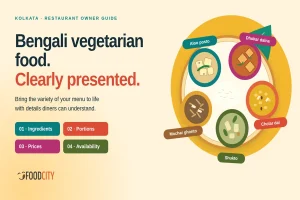

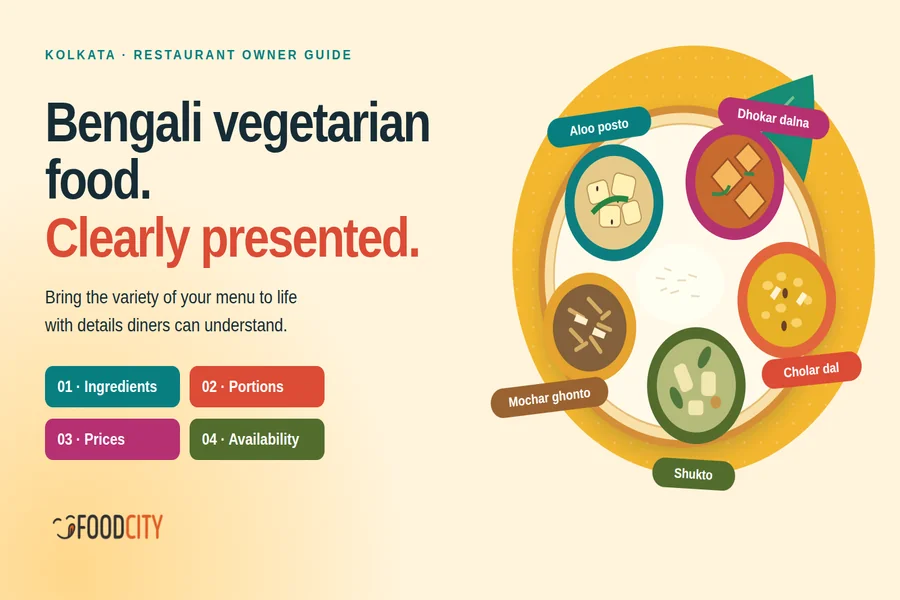
Preparing a Kolkata restaurant listing? Use Bengali vegetarian dishes to explain ingredients, portions, prices and availability clearly, while distinguishing a mixed-menu business from an exclusively vegetarian restaurant.
Make the vegetarian choices easy to understand
A useful restaurant listing preserves Bengali dish names while explaining ingredients, portions and accompaniments. If you plan to list your restaurant in Kolkata, prepare these details so readers can understand your vegetarian choices and what each price includes.
Describe the restaurant and the dishes separately
A mixed-menu restaurant can offer aloo posto alongside fish or meat. Describe it as a “Bengali restaurant with vegetarian and non-vegetarian dishes,” rather than an exclusively vegetarian business. Only mention separate preparation areas if genuinely provided.
For a starting point, browse restaurants in Kolkata in FoodCity’s Bengali cuisine collection. It is not a vegetarian-only selection, so readers still need to check each restaurant’s menu and preparation details.
Use familiar names, followed by useful explanations
Follow each name with a short explanation reflecting your kitchen’s actual recipe.
- Aloo posto: potatoes cooked with a poppy-seed paste. Mention the seasoning and whether your version is dry or has a little gravy. Confirm onion and garlic use rather than assuming it from the name.
- Dhokar dalna: fried cakes made from ground Bengal gram, served in a spiced gravy. State the number of pieces and whether potatoes are included. Identify ghee, nuts or other ingredients where used.
- Mochar ghonto: a preparation of banana blossom, often cooked with ingredients such as potato, coconut and Bengal gram. Clearly identify the vegetarian version; banana blossom is also used in preparations with prawns.
- Shukto: a name covering several preparations, including a mildly bitter mixed-vegetable version. Describe your vegetables and state whether milk, ghee or lentil dumplings are included.
- Cholar dal: split Bengal gram cooked in a Bengali sweet-savoury style. Mention coconut, raisins and ghee if used, and explain whether luchi or another accompaniment is included or sold separately.
Check the recipe before choosing dietary labels
Vegetarian, vegan and onion-and-garlic-free are different claims. In many Bengali recipes, niramish describes vegetarian food without onion and garlic; confirm your recipe, gravy and garnish before using that description.
Bong Eats documents an optional onion variation for alu posto and distinguishes vegetarian mochar ghonto from mocha chingri with prawns. Its dhokar dalna recipe includes peanuts, plain flour and ghee; its mixed-vegetable shukto includes milk and ghee. These particular recipes illustrate why labels such as vegan, nut-free or gluten-free require checking beyond the main ingredient.
What an actual Kolkata menu demonstrates
6 Ballygunge Place’s official vegetable menu describes aloo posto as potatoes with poppy seeds and states a 300 g portion. Aloo jhinga posto is listed separately with its gourd addition. The website also separates restaurant, Thali and Takeaway menus: a useful reminder to match menus to branches and service formats. Checked on 24 October 2026, these are presentation examples, not guarantees of availability.
Before-and-after descriptions
These fictional examples illustrate the structure; substitute your own verified details.
Aloo posto
Before: “Traditional Bengali potato special.”
After: “Potato cubes cooked in poppy-seed paste with green chilli and nigella seeds. One 180 g portion; rice and dal sold separately.”
Dhokar dalna
Before: “Delicious veg curry, full plate.”
After: “Four fried Bengal-gram cakes with potato in a ginger-and-cumin gravy, finished with ghee. Rice sold separately.”
Mochar ghonto
Before: “Mocha special.”
After: “Vegetarian banana-blossom preparation with potato, grated coconut and Bengal gram. One 160 g portion. Available at lunch on Saturdays, while the day’s batch lasts.”
Add milk or ghee where used, and verify portions and service days with the kitchen.
A sample vegetarian menu section
Illustrative example only: the prices, weights, ingredients and schedules below are fictional editorial examples, not FoodCity or restaurant offers. Rice and breads are sold separately in this sample. Prices include applicable taxes.
- Aloo posto — ₹140: potato with poppy-seed paste, green chilli and nigella seeds; 180 g. Available at lunch daily.
- Dhokar dalna — ₹180: four Bengal-gram cakes with potato in ginger-and-cumin gravy; contains ghee. Available at lunch and dinner daily.
- Mochar ghonto — ₹170: vegetarian banana blossom with potato, coconut and Bengal gram, finished with ghee; 160 g. Saturday lunch, while the day’s batch lasts.
- Mixed-vegetable shukto — ₹150: vegetables including bitter gourd and potato, with lentil dumplings, milk and ghee; 200 g. Available at lunch daily.
- Cholar dal — ₹110: sweet-savoury split Bengal gram with coconut, raisins and ghee; 200 ml. Available at lunch and dinner daily; luchi sold separately.
Use actual selling prices and consistent portions. For thalis, list contents, refill rules and substitutions. Distinguish pairing suggestions from inclusions: “pairs well with luchi” does not mean luchi is included.
Check these details before uploading
When comparing a restaurant listing website Kolkata owners can use, look at how clearly its profiles display the information customers need. Prepare one checked menu record for the branch you want to list.
- Ingredients: confirm the main ingredients, cooking fat, garnishes and relevant dietary details with the kitchen.
- Portions: specify pieces, weight or volume where practical. Avoid undefined “small” and “large” labels.
- Prices: check each amount against the current branch menu and clarify tax and packaging treatment where relevant.
- Accompaniments: explain whether rice, luchi, dal, chutney or other sides are included.
- Availability: record service days, lunch or dinner restrictions, seasonal changes and advance-order requirements.
- Branch information: use the correct business name, address, phone number and opening hours. Restaurant opening hours and dish availability may differ.
- Photos: use pictures of the actual preparation and serving size, with permission to publish them.
- Updates: assign someone to review the online menu whenever recipes, prices or schedules change.
Ask a reader: What is it? How much arrives? What comes with it? When is it available? Resolve any guesswork and keep a dated master menu.
Use the same standard for seasonal dishes and daily specials. A short note such as “available while today’s batch lasts” is more useful than leaving a popular item on the menu after it sells out. If a recipe changes, update its description and dietary notes together; otherwise a once-accurate label can become misleading.
When a dish name has several local variations, explain the version your kitchen actually serves. Do not imply allergy suitability unless the kitchen can confirm ingredients and preparation practices.
Prepare the enquiry, then confirm the next steps
FoodCity’s public enquiry form asks for the business name, contact person, role or position, phone number, email, business category and city or location. Have those details ready, along with the checked menu you want to discuss.
FoodCity describes restaurant listings and menu showcases among its services. Its initial form does not request a menu upload; keep your checked menu for follow-up and ask about assets, terms and edits. An enquiry starts the conversation rather than immediately creating an account or publishing a listing.
Serve Bengali vegetarian dishes in Kolkata? Use FoodCity’s enquiry form to list your restaurant in Kolkata and ask about presenting your menu. An enquiry is a first conversation; confirm the review process, any requirements and next steps with the team.